
Part Two
The Reverb Mystery & The “Wild West” of Cables
The transition from a quiet home office to a live international gig involves more than just a flight; it requires a mental shift into “performance mode.” After navigating Gatwick Airport—fueled by a quick burrito and a decaf coffee—I arrived in Turkey ready to get to work.
A Warm Welcome in Marmaris
Any initial nerves about the trip were immediately put to rest by the incredible hospitality shown by Derrick and Sheryl. Sheryl had kindly arranged a luxury private transfer from the airport, which allowed me to decompress and experience a traditional roadside chicken kebab during the late-night drive.
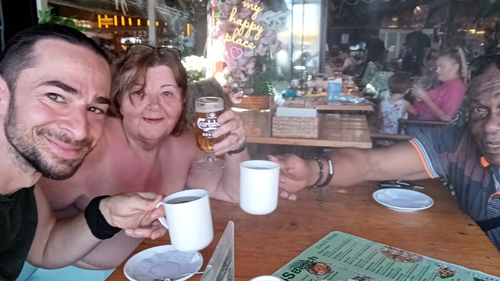
Meeting them for breakfast the next morning, I was struck by Sheryl’s warmth and her fascinating stories about Turkish history and the local culture of Marmaris. It was clear we were a solid team. That camaraderie is essential in live sound; when the technician and the artist trust each other, the music always sounds better.
The “Wild West” of House Sound
Our first gig was on Monday night. As soon as we arrived for the soundcheck, I knew I had my work cut out for me. As is common with many international holiday clubs, the house sound system was a “wild west” of tangled cabling and unlabelled ports.
While the venue staff were friendly, they weren’t used to a setup as sophisticated as ours. I had to hunt through a bird’s nest of wires to find the correct XLR inputs to get Derrick’s Boss RC-505 Loop Station integrated into the house desk without losing signal integrity.
Solving the “Reverb Mystery”
It was during this first soundcheck that my presence on the trip was truly justified. We encountered a bizarre technical hurdle: when Derrick plugged his microphone into the loop station and then into the venue’s mixer, the output was drowned in a “swamp” of overwhelming, cavernous reverb.
Despite zeroing out the reverb on the house mixer and testing different cables, the issue persisted. It sounded like the vocals were being processed twice. After digging into the deep system menus of the RC-505, I identified the culprit:
- The Problem: A routing conflict within the System / Input-Output settings. The “Input Line Out” was likely creating a digital feedback loop with the venue’s specific signal path, causing a phasing issue that mimicked—and amplified—the house reverb.
- The Fix: I reconfigured the internal routing of the RC-505 to ensure a “dry” signal was being sent to the desk while Derrick maintained his monitoring levels.
From Tech-Check to Rockstar
With the technical roadblock cleared, the difference was night and day. Derrick’s custom backing tracks—authentic 60s and 70s soul vibes we had spent years perfecting in his Manchester studio—sounded punchy, clear, and professional through the PA.
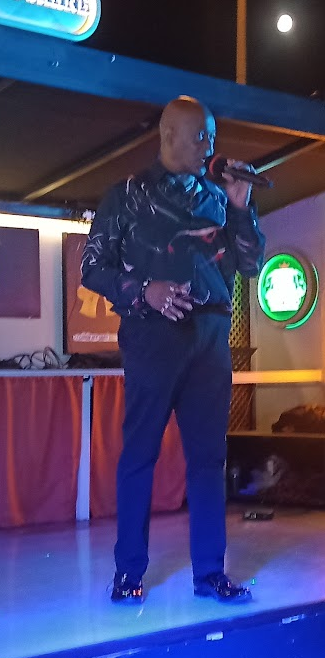
Derrick looked every bit the rockstar with his stage outfit and rings. For the first time, he wasn’t looking at the cables or the buttons; he was looking at the audience. He was ready to deliver the performance we had spent years preparing for.
A Successful First Gig
The first night was a victory, not just for Derek as a performer, but for our technical partnership. Having solved the mystery of the “swamped” reverb, I felt a huge sense of relief—and a deep sense of gratitude to Sheryl and Derek for their incredible support during those high-pressure moments. With the sound finally dialled in and the first show under our belts, it was time to swap the soundboard for some local scooters and prepare for an upcoming safari adventure.